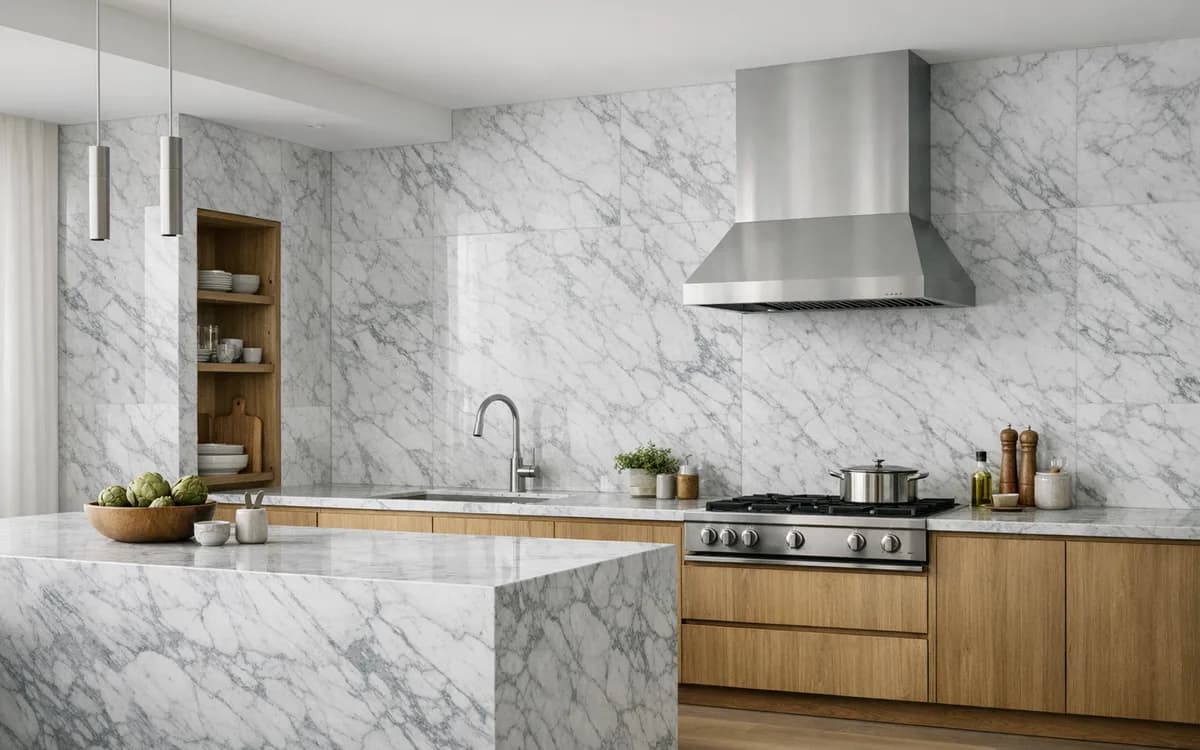
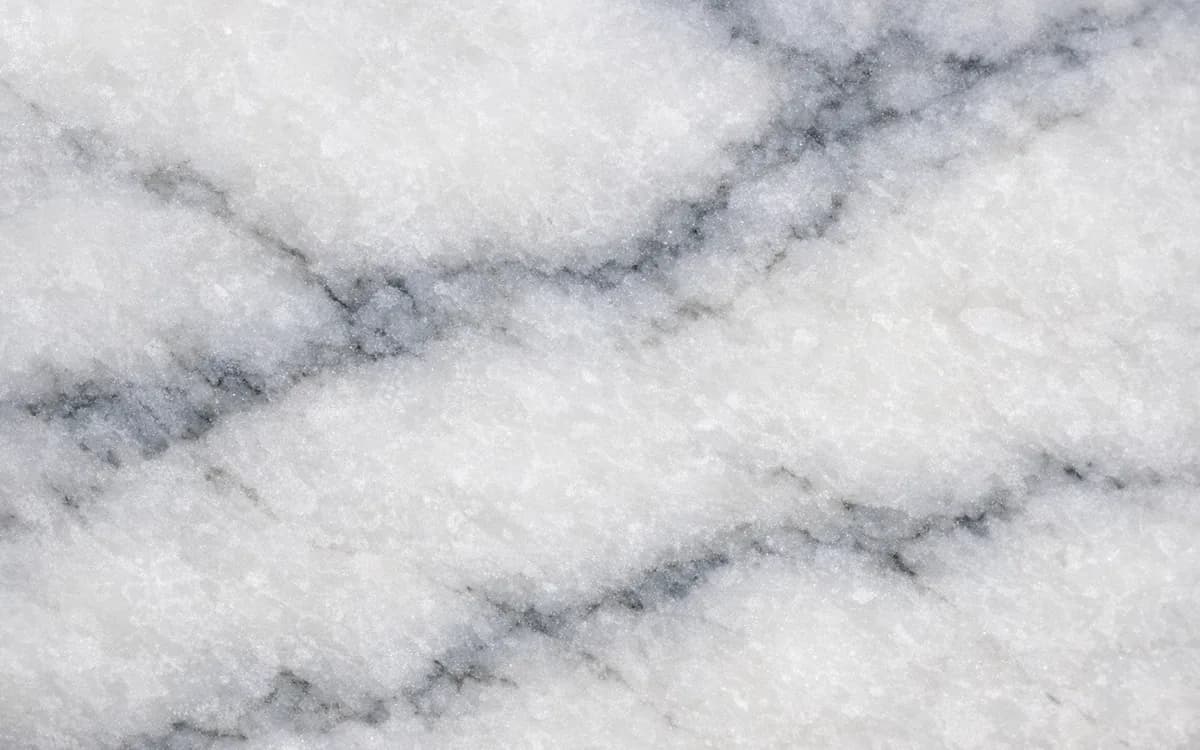
Carrara marble comes from the Apuan Alps in the Massa-Carrara province of Tuscany, Italy. Geologically it is metamorphic rock formed mainly from calcite — limestone transformed by heat and pressure deep in the earth, then lifted into mountains humans could eventually quarry.
Romans extracted marble here and shipped blocks across the Mediterranean for temples, public buildings, and monuments. That export culture turned a regional stone into a global name — long before modern slab showrooms existed.
The Apuan Alps are not a single quarry but a district of many operations — some open to visitors, others industrial scale. The stone varies from bright white with faint grey to distinctly blue-grey backgrounds with bolder veining. “Carrara” on a label usually means origin in this region, not one uniform appearance.
For homeowners, the historical prestige matters less than slab behaviour: Carrara is still calcite-based marble with the same acid sensitivity and sealing needs as other white marbles. The name carries weight in design conversations; geology carries weight at the sink.
Romans and the marble trade
Roman engineers developed roads and harbour infrastructure to move heavy blocks from the Apuan quarries to construction sites across the empire. Luna (modern-day Luni) served as an important export port. Columns, floor tiles, and façade cladding in Rome, North Africa, and southern France often trace back to this supply chain.
That early trade established Carrara as a benchmark for white building stone in Western architecture. When you see classical ruins with grey-veined white marble, you are often looking at a geological cousin of what still comes out of the same mountains today.
Renaissance sculpture and architecture
Renaissance artists including Michelangelo selected blocks from Carrara quarries for major sculptures. The stone’s relative workability compared with harder rocks, combined with white-grey tones, suited both figurative carving and interior prestige surfaces.
Architects valued consistent blocks for columns, floor fields, and cladding. The same geological story continues today: the name describes origin and general character, not one fixed appearance.
Sculptors inspected blocks for hidden fractures before carving — a practice still echoed when fabricators lay out kitchen templates to avoid weak zones around cut-outs. Vein direction that pleased a statue’s pose now pleases a waterfall island edge.
Renaissance palazzi in Florence and Genoa helped cement Carrara marble as a symbol of refinement. Modern luxury marketing still leans on that association, which is why Carrara-type stones appear in hotel lobbies, spa bathrooms, and high-end residential kitchens worldwide.
Modern quarrying and global trade
Contemporary Carrara operations use diamond wire saws, controlled bench cuts, and heavy logistics to move blocks from mountainsides to processing plants. Slabs are resined, polished or honed, and distributed to fabricators on every continent.
When you specify “Carrara” for a kitchen or bathroom, you are buying into that supply chain — but vein intensity, grey tone, and price still vary block by block. Always select from slabs, not only from the historical name.
Italy remains a major processor, but blocks may travel to factories in other countries for sawing and finishing before re-export. Ask your supplier where your slab was quarried and where it was processed — both steps influence lead time and cost.
Carrara competes in showrooms with other Italian whites (Calacatta, Statuario) and with marble-look porcelain. Its advantage is authenticity and often a softer visual field at a more accessible price than the most dramatic white marbles.
Choosing Carrara for your home today
Carrara suits homeowners who want Italian marble character without always paying top-tier Calacatta pricing. Greyer backgrounds can forgive daily kitchen patina better than large polished white fields — especially in honed finishes.
Pair historical appreciation with practical habits: sealing, pH-neutral cleaners, cutting boards, and realistic expectations about etching. Carrara has decorated elite spaces for two millennia; it can work in your kitchen if you treat it as natural stone, not as indestructible laminate.